How to Read Piping Plan Drawing
What is Piping Isometric Drawing?
Once the three-dimensional (3D) model has been established in pipage design software similar PDS, PDMS, or SP3D, Pipe Designers/Engineers demand to convey that information to the yard for fabrication and site for Construction. The transferred information must take to be sufficient for the fabricator with the vision of what is to be fabricated and how the piping should be connected with other elements, with verbal dimensions and complete build/Bill of materials (BOM). This is where Pipage Isometric Drawings play a magnificent role. So piping isometrics are straight used for the following situations:
- For Construction Services
- For marking up deviation during site modifications/ as-builting.
- For reference as Stress Assay model built upwardly and final stress marker upwards for updating stress requirements.
Piping isometrics indirectly helps to calculate many parameters required during project execution similar:
- Inch Meter can be estimated as Length of piping (in meter) x Size of pipe ( in inch )
- Inch Dia is calculated as Size of Pipe joint ( in inch) x No, of Joints
- Pipe Weight is calculated as π x diameter of the pipage (in thousand) x length (in grand) x thickness (in mm) ten density of pipe fabric. Density of CS = 7.85 g/cm3
- The volume of H2o required for hydro testing is estimated as π x {Piping ID (in meter)}² ten Length of Pipe
- Insulation Surface area (in m²) can exist found as [π(Piping OD+ insulation thickness)] (all in meter) 10 Length of Pipe (in meter)
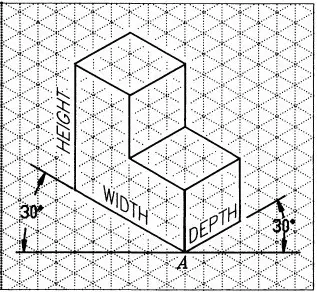
By definition, Isometric drawings are a pictorial representation that combines height-width-depth/length into a single view with 30 degrees from its horizontal plane equally shown in the below fastened prototype.
Features of Piping Isometric Cartoon
Isometric Drawing is a two dimensional (2d) drawing that represents the 3D pipe organisation. The important features are
- Information technology is non drawn to the scale, but it is proportionate with verbal dimensions represented.
- Pipes are fatigued with a unmarried line irrespective of the line sizes, as well as the other configurations such as reducers, flanges, and valves.
- pipes are shown in the same size. The actual sizes are notified in Bill of Textile, tagging, phone call-out, or notes.
- A piping isometric drawing provides all the required information similar:
- Pipe Line Number
- Continuation isometric number
- Flow direction
- Pipage dimensions
- Piping joint types, weld types
- Flange and valve types
- Equipment connection details
- Piping and Component descriptions with size, quantity, and textile codes
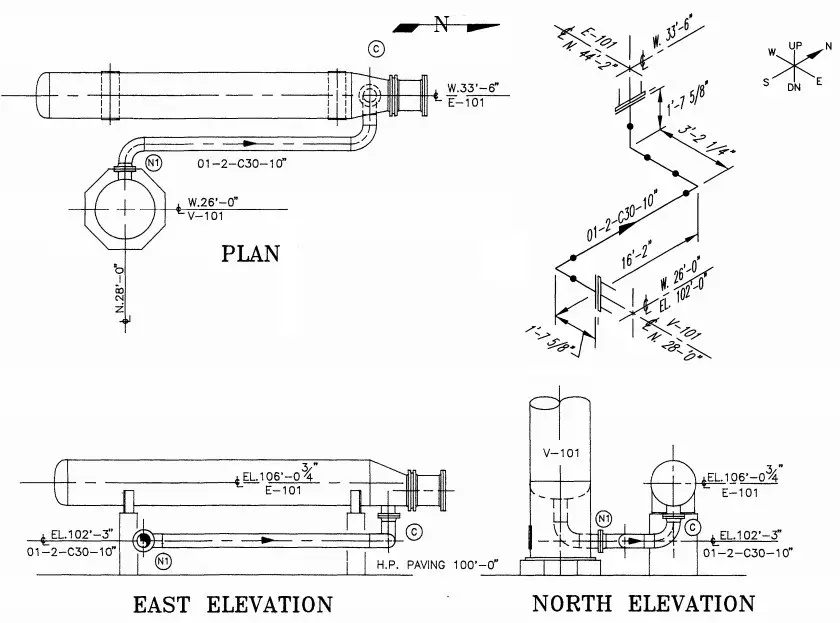
Piping Isometric drawings are popular considering of their simplicity yet efficiency to convey complex data. The following figure gives an instance of how one Isometric drawing can represent three orthographic drawings. That is just a simple pipage drawing. Imagine complex design and yet orthographic drawings are used for construction, that is really a headache.
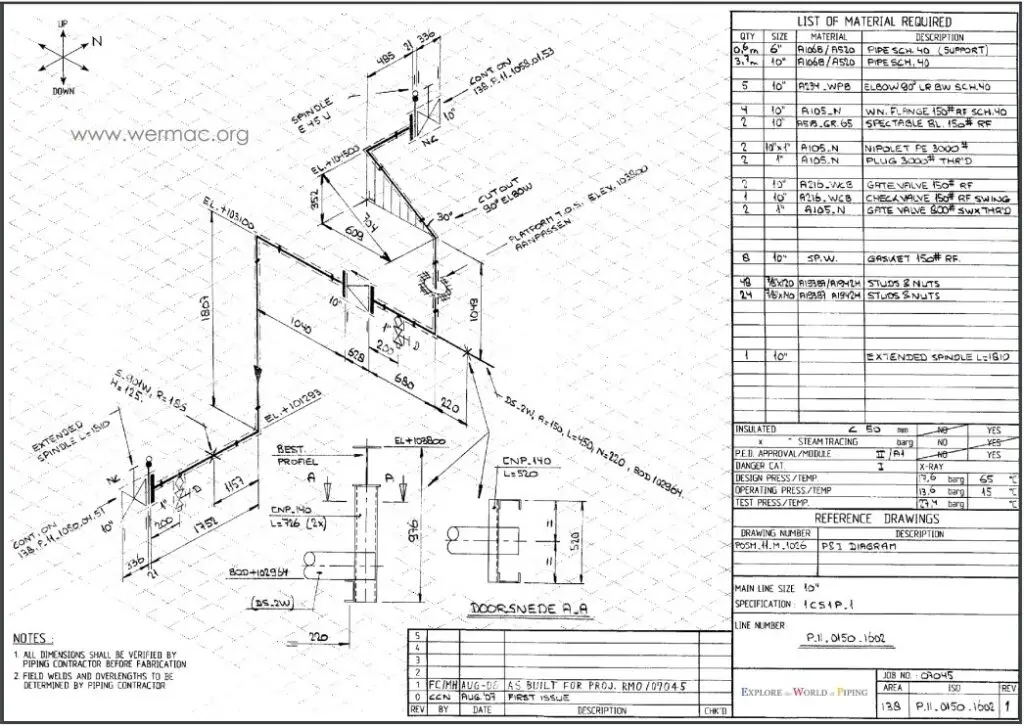
In earlier days, Isometric drawings were paw-drawn. With the innovation and advocacy of the digital age, isometrics are drawn by AutoCAD/Microstation software. In recent days, the 3D models could automatically extract the Isometric with a single click of a mouse.
How to Read Piping Isometric Drawings?
one. First, imagine that the piping system is congenital in a box. This basic imagination is required for the piping to accept an offset. And so, it volition help y'all to imagine, how the piping configuration volition wait like as it travels.
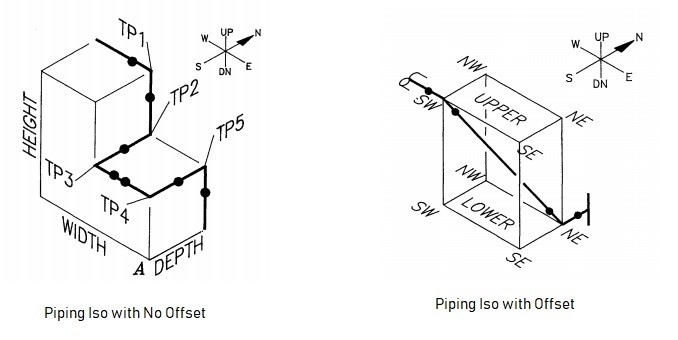
ii.Offset happens when the pipage turns to any angle other than 90-degree or to accommodate odd nozzle's location or tie in point connections. A popular use is a 45-degree elbow and this is used extensively in pipe design. In such cases, piping design may state on Northeast, Southeast, Northwest, or Southwest axes. In society to check the dimension of piping length with start, common Pythagoras's theorem and Trigonometric rule tin be used. A sample calculation is shown below as a reference-
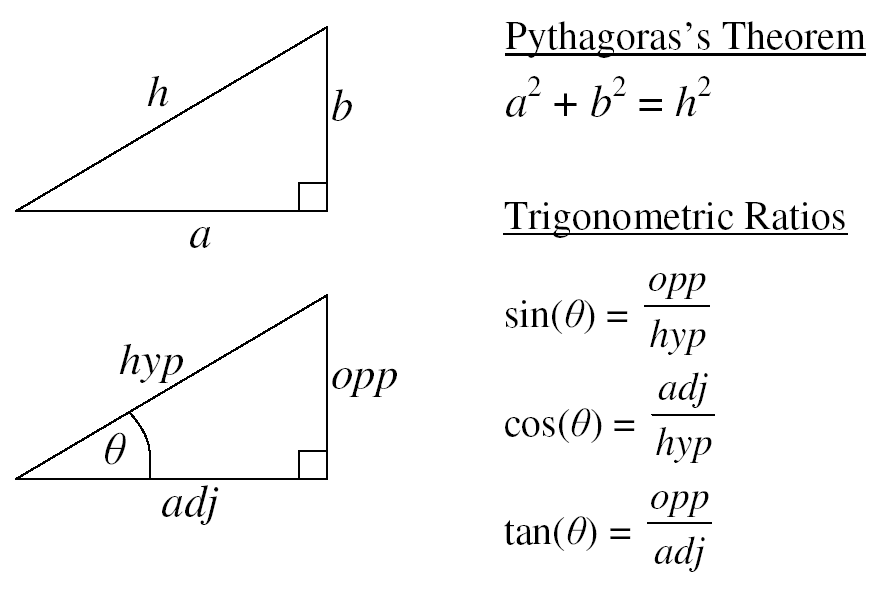
Case of length calculation in Pipage Isometric
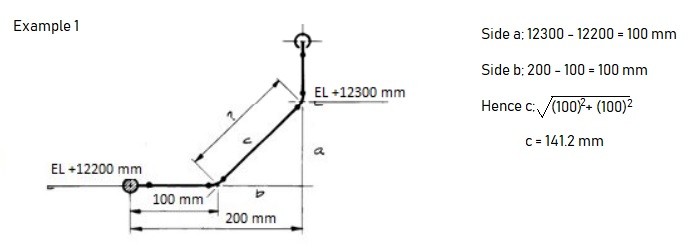
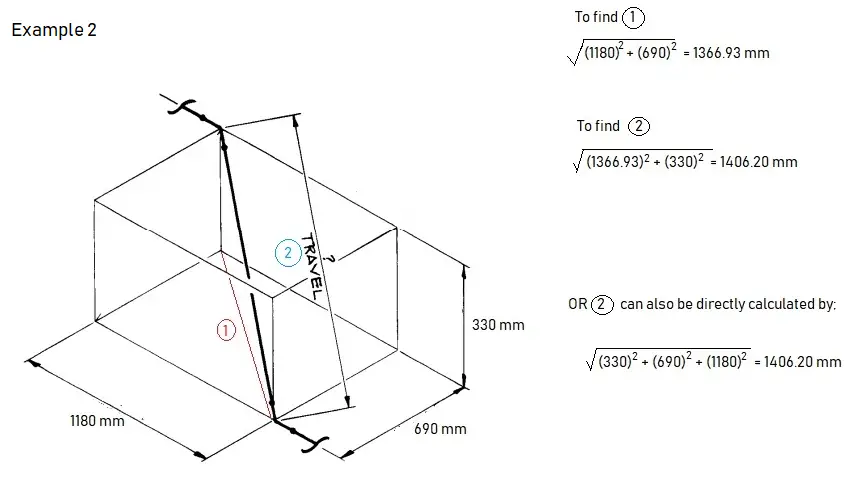
Example of offset
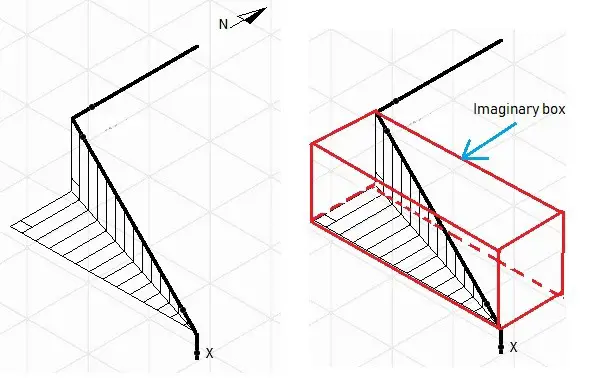
If y'all happened to have difficulties in reading the commencement, try to draw the imaginary box. It could assist you in having a better agreement of which axes the piping travel and how the piping should look like. In the instance given, take the flow from 'x', the pipe goes upwardly; then up-northwest; then north. As you lot get along with Iso a lot, things will come naturally.
3. A Due north pointer is provided in all piping isometrics to inform the location of the piping arrangement in piping/ general arrangement drawing.
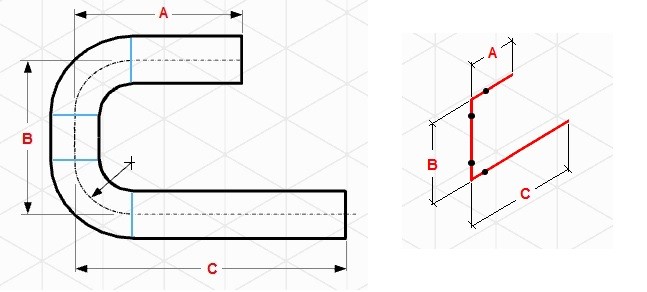
four. The pipe isometrics as well hascoordinates & superlative detailed information to verify the verbal length of pipe in horizontal and vertical axes respectively. The dimensions in Isometric drawings are measured from the piping centreline and non from the outer bore of the pipe (refer to the image attached beneath for reference).
With the advancement of engineering science, in that location could be minimum or even cypher possibilities that the North pointer, coordinates, and top in Isometric would differ from the pipe arrangement; hence the dimensions and MTO should match exactly if the source 3D model is the aforementioned.
Still, It is ever better to check and verify every bit there could be some bug with the modeling itself that may cause discrepancies in material and quantity. For instance, if double piping is modeled by mistake, it will read the double quantity of material.
five. Isometric drawings too inform which pipe should be synthetic at the fabrication store and which should exist assembled at the construction/platform field itself. The complete piping system is separated into pieces that are transported to the site for erection. These pocket-size pipe pieces are termed pipe spools. I sheet of Isometric drawing normally has few spools.
Every weld that is assembled betwixt spools at the structure site is termed afield weld (FW). There is ane more blazon of weld that is known as field-fit weld (FFW). This FFW is defined past the designer if he/she could foresee that the spool might require some aligning earlier the final fit-upwardly, so at the location of FFW has been marked, information technology volition exist given some pipage length tolerance (commonly 150-300mm). Ordinarily, FFW volition occur at the nozzle of equipment or tie-in locations.
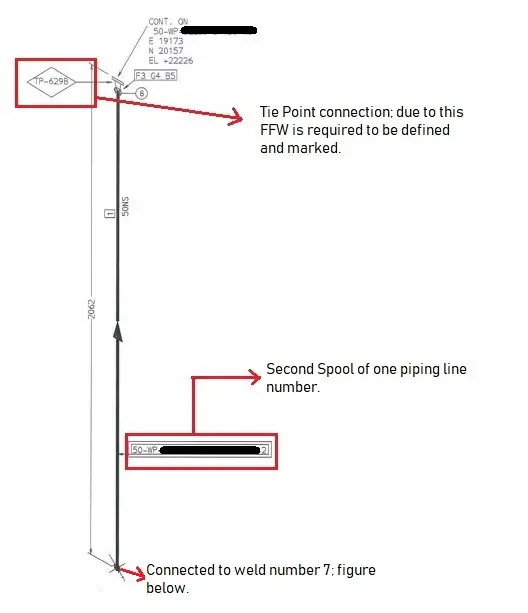
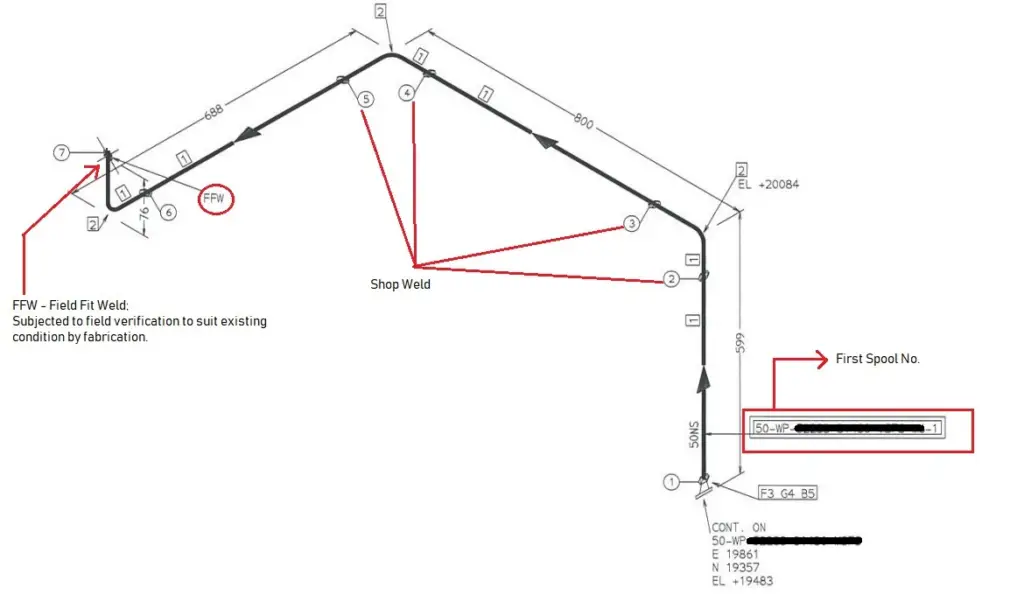
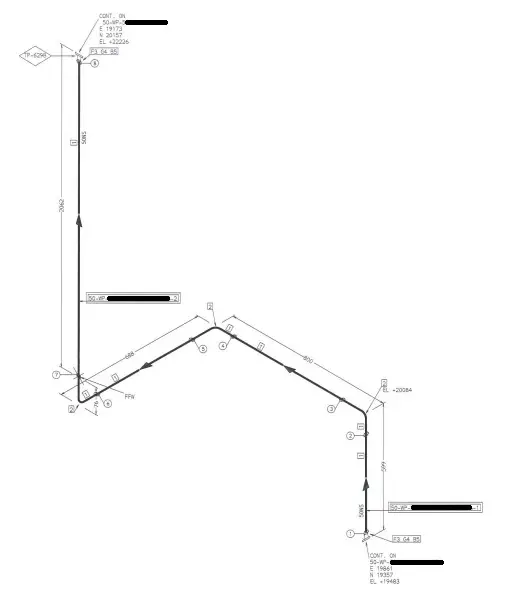
The whole assembled piping volition look like the following afterward it is assembled at the field.
Piping isometric drawing symbols
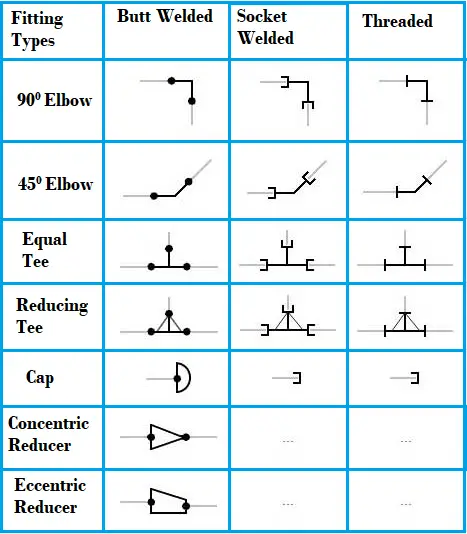
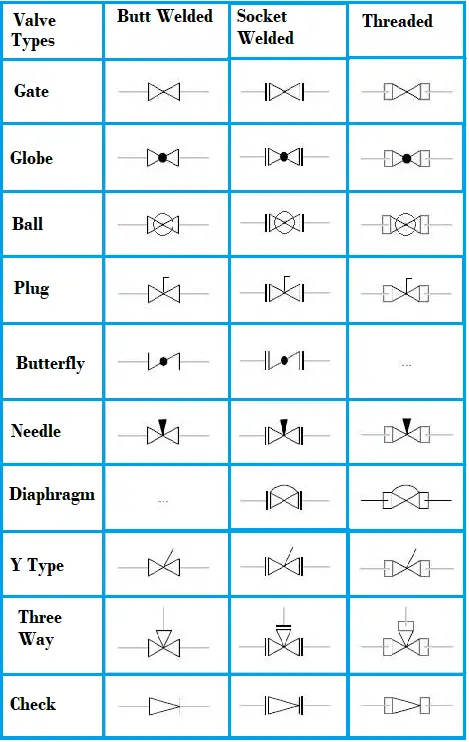
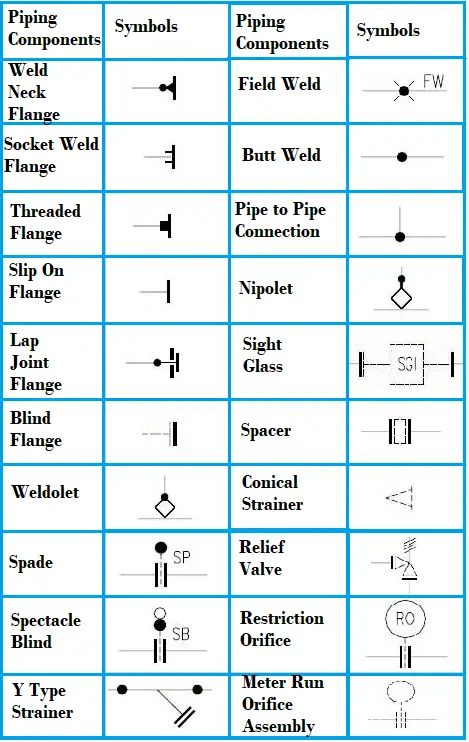
For reading and agreement a pipage isometric drawing, one should larn the piping isometric drawing symbols thoroughly. Ordinarily, all these piping and pipeline drawing symbols are constant and does non vary much from one organization to the some other. Knowing the piping drawing symbols volition provide diverse information like:
- Type of Piping Joint: Pipage and pipeline drawing symbols throw lights on the blazon of articulation like Buttweld, socket weld, or Threaded.
- Type of pipage Components: Isometric drawing piping symbols serves every bit a set reference for blazon of fittings and components.
- Musical instrument items: Knowing the piping isometric symbols will help in recognizing the musical instrument and special pipe items in the isometric.
- Equipment Connexion: Equipment connected to a pipe system is also understood with piping symbols.
- Knowing piping symbols for isometric drawing is useful in preparing MTO/BOM.
Normally used piping isometric drawing symbols are shown below for reference purpose
Video Tutorial of Basics of Piping Isometric Drawing
The following video tutorial on the nuts of piping isometric cartoon volition clarify some of your doubts.
Some more Resources for you…
Salient Points to check while reviewing Piping Isometric Drawings
Preparation of Piping Isometrics
Types of Piping Drawings
References
- Credit to other sources: svlele.com, wermac.org, pipingengineer.org, thepiping.com, spedweb.com, enggcyclopedia.com, rishabheng.com
- https://www.sciencedirect.com/topics/engineering/pipe-isometric

Source: https://whatispiping.com/basic-piping-isometric-drawings/
0 Response to "How to Read Piping Plan Drawing"
Post a Comment