Read the Text Again and Answer the Questionswho Designed and Built the First Earthship
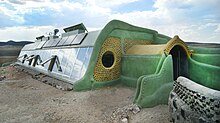
Southward and East view of an Earthship passive solar home

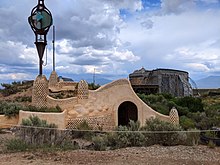
Earthship Architecture, Taos, New Mexico
An Earthship is a style of compages adult in the tardily 20th century to early on 21st century by builder Michael Reynolds. Earthships are designed to behave as passive solar earth shelters made of both natural and upcycled materials such as earth-packed tires. Earthships may feature a diversity of amenities and aesthetics, and are designed to withstand the farthermost temperatures of a desert, managing to stay close to 70 °F (21 °C) regardless of outside weather weather condition. Earthship communities were originally built in the desert of northern New United mexican states, well-nigh the Rio Grande, and the style has spread to small pockets of communities around the globe, in some cases in spite of legal opposition to its construction and adoption.
Reynolds developed the Earthship pattern subsequently moving to New Mexico and completing his degree in compages, intending them to be "off-the-filigree-ready" homes, with minimal reliance on public utilities and fossil fuels. They are constructed to utilize bachelor natural resource, particularly energy from the lord's day and rain water. They are designed with thermal mass structure and natural cantankerous-ventilation to regulate indoor temperature, and the designs are intentionally uncomplicated and mainly single-story, so that people with fiddling building knowledge can construct them.

Earthship windows, water barrels, and solar panels
History [edit]

Michael Reynolds' kickoff building, the "Thumb Firm", was built in the early 1970s. It included features incorporated into later on Earthship designs.
Earthship architecture began development in the 1970s, when the architect Michael Reynolds set out to create a dwelling that would fulfill three criteria. First, it would utilise sustainable architecture, and material indigenous to the local area or recycled materials wherever possible. Second, it would rely on natural energy sources and be independent from the electrical grid. Third, it would be feasible for a person with no specialized construction skills to build. Eventually, Reynolds'due south vision was transformed into the common U-shaped world-filled tire homes seen today.
The name is based on the idea of a ship or a space ship, in lodge to allude to the dwelling house'south ability to provide everything for their inhabitants to survive: shelter, power, waste direction, water, and food.

Construction and design [edit]

Edifice with cans in the 1970s
Earthships are predicated upon the idea that at that place are half dozen homo needs which can exist addressed through environmentally sustainable building design:[1]
- Energy: Thermal and/or solar heating and cooling, solar and wind electricity
- Garbage management: Reuse and recycling congenital into construction and daily living
- Sewage handling: Cocky-contained sewage handling and h2o recycling
- Shelter: Building with natural and recycled materials
- Make clean Water: Water harvesting and long term storage
- Nutrient: In-home organic food product adequacy
The buildings are oftentimes horseshoe-shaped due to the difficulty of creating sharp 90 degree angles with rammed tires. In Reynolds's prototype at Taos, the opening of the horseshoe faces ten–15 degrees due east of s to maximize natural light and solar-gain during the wintertime months, with windows on lord's day-facing walls albeit light and heat.
The volume, Earthship I, describes how to find the best bending depending on the building'south geographic location. The thick and dumbo walls provide thermal mass that naturally regulates the interior temperature during both cold and hot exterior temperatures. The outer walls in the majority of Earthships are made of globe-rammed tires, simply any dense material with a potential to store heat, such as concrete, adobe, earth numberless, or stone, could in principle exist used to create a building like to an Earthship. The tire walls are staggered like traditional brick work, and often have "physical half blocks" every other form, to equal the length of the staggered tire below. In an effort to cut down the use of concrete fifty-fifty further, they besides use "squishies" - tires rammed in between a tight space to fifty-fifty out the grade or to compensate for varying tire size.

Nearly earthship structures are world-sheltered buildings with a large series of windows and used tires
The rammed earth tires of an Earthship are assembled by teams of two people. One person shovels dirt and places it into the tire one scoop at a time. The other person, who stands on the tire, uses a sledgehammer to pack the dirt in while moving in a circle effectually the tire to keep the dirt even and to avert warping the tire.[two] Rammed earth tires can weigh upwards to 300 lb (140 kg), so they are typically filled in place. Considering the tire is full of soil, it does not fire when exposed to fire.[3] In colder climates, extra insulation is added on the outside of the tire walls.

Tires rammed with earth and stacked
On top of the tire walls are either "can and concrete bond beams" made of recycled cans joined by concrete, or wooden bond beams with wooden shoes. These are attached to the tire walls using concrete anchors, poured blocks of concrete inside the pinnacle tires. Wooden shimming blocks placed on top of the wooden bond beam make up the wooden shoes. The wooden bond axle consists of ii layers of lumber bolted on to the concrete anchors. Re-bar is used to "nail" the wooden shoes to the wooden bond beam.
Internal, not-load-bearing walls are frequently made of a honeycomb of recycled cans joined by concrete; these are nicknamed tin walls. These walls are commonly thickly plastered with adobe, and resemble traditional adobe walls when finished.
The roof is made using trusses, or wooden support beams chosen vigas, that rest on the wooden shoes or the tin tin can walls placed on the bond beams. The roof likewise as the north, east and w facing walls are heavily insulated to reduce heat loss.
The average cost in 2019 including labour and land is about $500,000.[ citation needed ]
Water [edit]
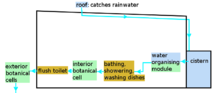
The water organization with integrated flush toilet, as used in most earthships

Earthships are designed to grab all the water they need from the local environment. Water used in an Earthship is harvested from rain, snow, and condensation. As water collects on the roof, it is channeled through a silt-communicable device and into a cistern. The cisterns are positioned to gravity-feed a water organisation module (WOM) that filters out bacteria and contaminants, making it suitable for drinking. The WOM consists of filters and a DC-pump. Water is then pushed into a conventional pressure tank to create common household water pressure.
Water collected in this fashion is used for every household activeness except flushing toilets. The toilets are flushed with greywater which has been used at least in one case already. Typically it is filtered waste-water from sinks and showers.

An interior botanical cell; the plants function every bit h2o treatment for graywater
Greywater, recycled water unsuitable for drinking, is used inside the Earthship primarily for flushing toilets. Before the greywater tin be reused, it is channeled through a grease and particle filter/digester and into a thirty–60 in (760–i,520 mm) deep rubber-lined botanical cell,[4] a miniature living machine, inside the Earthship. Here the water is oxygenated and filtered using bacteria and plants to reduce the nutrient load.[v] H2o from the low finish of the botanical cell is directed through a peat moss filter and collected in a reservoir or well. The reclaimed water is passed once more through a greywater board and used to flush conventional toilets.
Blackness water is water that has been used in a toilet. Earthships utilize anaerobic digestion in their septic tanks, which naturally divide solid waste. The black h2o is used in physical cells containing plants, split from the grey water plants in the greenhouse; it may as well be used in exterior planters. Studies on the safety of growing food plants in a black water system show low levels of E. coli bacteria. Information technology is non recommended to plant edibles in blackness water; building permits may be refused for plans indicating such usage of black water.
Where it is non possible to use flush-toilets operating on water, dry solar toilets are recommended.
Power [edit]

Solar panels on an Earthship
Earthships are designed to collect and store their ain free energy. The bulk of electrical energy is harvested from the sun and wind. Photovoltaic panels and wind turbines on or about the Earthship generate DC electricity that is stored in deep-cycle batteries. The batteries are housed in a purpose-built room on the roof. Additional energy can be obtained from gasoline-powered generators or by integrating with the metropolis grid. For Canadian winters the solar cell exposed surface areas needs to be increased by over three times.[ citation needed ]
In an Earthship, a Power Organizing Module (POM) takes a proportion of stored free energy from batteries and invert it for Air conditioning utilize. The Power Organizing Module is a prefabricated system provided by Earthship Biotecture that is simply fastened to a wall on the interior of the Earthship and wired in a conventional manner. It includes the necessary equipment such as excursion breakers and converters. The energy run through the Power Organizing Module can be used to run any household appliance including washing machines, computers, kitchen appliances, print machines, and vacuums. Ideally, none of the electric energy in an Earthship is used for heating or cooling.[ commendation needed ]
Thermal functioning [edit]

Solar water heater on an Earthship
Earthships rely on a remainder between the solar heat gain and the ability of the tire walls and subsoil to transport and shop oestrus. They are designed to use the properties of thermal mass and with the intent that the exterior world-rammed tire walls provide thermal mass that volition soak up heat during the solar day and radiate heat during the night, keeping the interior climate relatively comfortable all day. In addition to the exterior tire walls, some Earthships are sunk into the world to take reward of earth-sheltering to reduce temperature fluctuations.
Some earthship structures have suffered from estrus loss into the ground during the heating flavour. This may be due to climatic differences betwixt New Mexico where earthships were first built and cloudier, cooler, and wetter climates. Thermal operation problems may as well accept occurred due to thermal mass existence erroneously equated to R-value. The purple R-value of soil is about 1 per foot.[half-dozen] Malcolm Wells, an architect and authorization on globe-sheltered design, recommends an imperial R-value 10 insulation between deep soils and heated spaces. Wells's insulation recommendations increase every bit the depth of the soil decreases (a negative correlation).
In add-on to thermal mass, Earthships use passive solar heating and cooling. Large front windows with integrated shades, trombe walls and other technologies such as skylights or Steve Baer'due south "Track Rack" solar trackers are used for rut regulation. Earthships are positioned so that its principal wall, which is nonstructural and made mostly of glass sheets, faces straight towards the equator. This positioning allows for optimum solar exposure. To allow the lord's day to heat the mass of the Earthship, the solar-oriented wall is angled so that it is perpendicular to light from the wintertime sun. This allows for maximum exposure in the winter, when rut is wanted, and bottom exposure in the summer, when heat is to be avoided. Some Earthships, especially those congenital in colder climates, utilize insulated shading on the solar-orientated wall to reduce rut loss during the night.[5]
Current Earthship designs like the global module take a "double greenhouse" where the outside glass is angled towards the equator, and an internal glass wall forms a walk manner or hallway as you lot pace into the Earthship. This greenhouse is primarily used to grow food; it likewise creates a barrier for the 'comfort zone' inside the house.
Ventilation [edit]

Natural convection cooling an Earthship
Earthships structures have a natural ventilation system based on convection. A thirty ft (nine.i m) pipe extends from the interior of the business firm under the berm, cooling the air past the time it gets to the comfort zone. As the hot air rises, the organization creates a steady airflow - of libation air coming in, and warmer air blowing out though a smaller vented window in the greenhouse.[ citation needed ]
Around the earth [edit]
Africa [edit]

Earthship built by Angel and Yvonne Kamp in Due south Africa
The commencement earthship in Due south Africa was congenital by Affections and Yvonne Kamp between 1996 and 1998. They rammed a full of 1,500 tires for the walls. The Earthship, near Hermanus, is located in a sixty hectare private nature reserve which is part of a 500 hectare surface area enclosed in a game argue and borders the Walker Bay Nature Reserve.[ citation needed ]
The 2d earthship in South Africa is a recycling centre in Khayelitsha run every bit a swop shop concept. The eye was finished in Dec 2010.[seven] Another low cost house built with tires is in development in Bloemfontein.[8] [9]
A project nearing completion in South Africa is a combined living quarters and the Sonskip / Aardskip open air museum in Orania.[10] This earthship is based on the global earthship model and is built with a foundation of tires, has roof bearing walls built with earthbags, and interior walls built with cob, cans and plastic bottles. This earthship adheres to all six principles of an earthship. This is the largest earthbag earthship in the world.[11]
A residential business firm was in the planning phase for Swaziland in 2013.[12]
In 2011, construction began on the Goderich Waldorf School of Sierra Leone. The school was the start educational institution to use earthship architecture. Although Mike Reynolds and a team of interns helped complete the get-go two classrooms, the majority of the edifice was built by community members who had been trained in Reynolds' building techniques.[13] [14]
A new project was scheduled to commence in Malawi in Oct 2013.During that first visit, the team was able to consummate two of the intended 8 rooms.[fifteen] Biotechure Planet Earth came back to collaborate on the Malawi project in 2015 in order to complete the community middle for the rural village.[sixteen] The crew was made up of a group of volunteers as well as locals all made up to create an 8 room building fabricated out of tires, cans and bottles. Finally, in a webpost uploaed on February 2020, it was confirmed that the community structure in Kapita, Malawi was able to be finished. [17]
Australia [edit]
Earthship Ironbank was built by Martin and Zoe Freney south-east of Adelaide in South Australia and is the first earthship constructed with council permission in Australia.[eighteen]
Europe [edit]
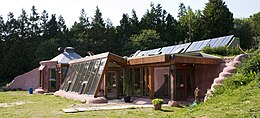
In 2000, Michael Reynolds and his team came to build the first residential earthship in Boingt (Belgium). While water, ability module, solar panels and the team were on their manner to Europe, the mayor of Boingt put his veto on the building permit. Josephine Overeem, the adult female who wanted to build the earthship, and Michael Reynolds decided to do a demonstration model in her back chiliad at her residence in Strombeek (Kingdom of belgium). CLEVEL[19] invited Reynolds from Belgium to Brighton in the Britain, and orchestrated plans for the earthship in Brighton, started in 2003. This was the beginning of a series of trips made by Reynolds and the construction of earthships in the UK, France and kingdom of the netherlands.
In 2004, the very get-go Earthship in the United kingdom was opened at Kinghorn Loch in Fife, Scotland. It was built by volunteers of the SCI charity. In 2005, the first earthship in England was established in Stanmer Park, Brighton with the Low Carbon Trust. In 2007, CLEVEL and Earthship Biotecture obtained planning permission to build on a evolution site overlooking the Brighton Marina in the Uk. The application followed a six-month feasibility study, orchestrated by Daren Howarth, Kevan Trott and Michael Reynolds and funded by the UK Environment Agency and the Free energy Savings Trust. The successful awarding was for 16 i, two, and three-bedroom earthship homes on this site, expected to have a sale price of 250 - 400,000 pounds.[twenty] The homes are all designed according to basic earthship principles developed in the United states and adjusted to the UK. 15,000 tires will be recycled to construct these homes (the UK burns approximately twoscore million tires each year). The plans include the enhancement of habitats on the site for lizards that already live there, which is the reasoning backside entitling the project "The Lizard". This would have been the showtime development of its kind in Europe.[21]
The offset official Earthship abode in mainland Europe with official planning permission approving was built in a pocket-sized French village chosen Ger. The home, which was endemic by Kevan and Gillian Trott, was built in April 2007 past Kevan, Mike Reynolds and an Earthship Crew from Taos, it was sold to a family unit in 2014. The design was modified for a European climate and is seen as the start of many for the European arena. It is currently used as a holiday home for eco-tourists.[22]
Farther adaptation to the European context was undertaken by Daren Howarth and Adrianne Nortje in Brittany, France. They obtained full planning permission in 2007 and finished the Brittany Groundhouse every bit their own home during 2009. The build feel and learning is documented in the UK Grand Designs serial and in their book.[23]
Earthships have been built or are beingness congenital in Portugal, Spain, France, Belgium, The netherlands,[24] United kingdom of great britain and northern ireland, Sweden, Denmark, Germany, Estonia and Czech republic.
The first official earthship district (23 earthships) in Europe was developed in Olst (kingdom of the netherlands). Building started in Spring 2012[25] and completed in December, 2014.[26] In Kingdom of belgium, one earthship hybrid is also being built, intended as demonstration buildings. Since it is illegal to utilise tires in Belgium (for risk of leaking toxic metals like lead and zinc),[27] the project uses earthbags instead.
The Earthships built in Europe by Michael Reynolds have to be adjusted to perform equally intended. Some showed bug with moisture and mould.[28] Some research into thermal performance was washed by the University of Brighton on the Brighton Earthship.[29] [thirty] The showtime successful construction of an Earthship in Germany (Tempelhof/Kreßberg, 2015/16) used fewer thermal bridges merely increased insulation in cooperation with a Fraunhofer Institute to preclude any mould problems.[31]
Key America [edit]
An earthship was constructed in 2015 by the Atkinson family in southern Belize. Information technology featured on the June 2015 Great britain Channel 4 Goggle box programme Escape to the Wild, season 1, episode 3.
Guatemala also hosts two earthships.[32]
S America [edit]
The offset Earthship in South America was built in Jan 2014 in the boondocks of Ushuaia, Tierra del Fuego, Argentina. Today this building functions as a visitor middle and example of self-sustainable living.[33]
In March 2016, an Earthship schoolhouse was built in Jaureguiberry, Uruguay.[34] In May 2018, another Earthship school was built in Mar Chiquita, Argentina.[35]
In pop culture [edit]
The moving-picture show Garbage Warrior is about Earthships and Reynolds' struggle with obtaining permits to build out of unconventional material and off the grid.
Encounter also [edit]
- Hurricane-proof building
- Permaculture
- Peter Vetsch
- Repurposing
- Solar thermal energy
Notes [edit]
- ^ "Earthship Design Principles". Earthship.com. Earthship Biotecture. Retrieved xv July 2016.
- ^ McHenry, Paul Graham. (1989) [1984]. Adobe and rammed earth buildings : design and construction. Tucson: University of Arizona Press. ISBN0816511241. OCLC 19849881.
- ^ "An Earthship goes through the Hondo Fire!". earthship.org. Earthship Biotecture, LLC. Archived from the original on 28 March 2012. Retrieved 5 February 2015.
- ^ "The Earthship Academy experience". Retrieved 23 August 2015.
- ^ a b Reynolds, Mike (2000). Comfort In Any Climate. Taos, New Mexico: Solar Survival Press. ISBN0-9626767-iv-8.
- ^ "Free energy Extension Service: Building ENVELOPE: Basement". ksu.edu. KSU Engineering Extension. Archived from the original on 27 October 2012. Retrieved 5 February 2015.
- ^ E, Michael (November 11, 2010). "khayelitsha earthship: assist fix canvass for a new housing destination". UrbanSprout . Retrieved xiv May 2013.
- ^ Everson, Ludwig (December 22, 2012). "Aardskip.com supports Qala Tala to create earthship RDP housing". aardskip.blogspot.com. aardskip.com. Retrieved fourteen May 2013.
- ^ "Qala Tala Project". Growing Tomorrow (AgriTV). The Weekly. January eighteen, 2013. Retrieved xiv May 2013.
- ^ "Where in the earth is Projection Aardskip?". aardskip.com . Retrieved 14 May 2013.
- ^ "Top Travel in Orania".
- ^ Harding, Stewart. "Annal for the 'Swaziland Project' Category". earthships.co.za. Archived from the original on x October 2013. Retrieved 14 May 2013.
- ^ Elliot, Sam (March 21, 2012). "Ten Days in Africa". earthship.com. Earthship Biotecture. Retrieved 14 May 2013.
- ^ Hughes, Amanda. "University of Cincinnati alum builds homes with recycled materials". UC Mag (May 2009). Retrieved xiv May 2013.
- ^ Nardone, Jeane (April 5, 2013). "Earthship Malawi, Africa – Join Us!". earthship.com. Earthship Biotecture. Retrieved 14 May 2013.
- ^ {{cite web|url=https://www.biotectureplanetearth.org/projects/malawi-africa/
- ^ https://earthshipbiotecture.com/kapita-malawi-earthship/.
- ^ Freney, Martin. "From world, cans and tyres: Earthship Ironbark - Renew". Renew . Retrieved nineteen October 2018.
- ^ "Carbon Offsets - Carbon Offsetting - Carbon Neutrality - CLevel". C LEVEL . Retrieved 23 August 2015.
- ^ "Docking into mother earthship". Eco Home News . Retrieved 23 August 2015.
- ^ Earthship Homes development (archived from the original on 2007-12-13).
- ^ Kevin Telfer, Super green European breaks (26 Apr 2008 ), The Guardian.
- ^ "Groundhouse - Earthship in Brittany". Groundhouse . Retrieved 23 August 2015.
- ^ Annette Toonen. "Duurzaam theedrinken in aardehuis," in NRC Handelsblad, 20 November 2008; In 2008 an Earthship teahouse was built in Zwolle, initiated by Theo Lalleman and the OWAZE Foundation.
- ^ "The project". aardehuis.nl. 2012-06-xviii. Archived from the original on 2013-04-10.
- ^ Gorter, Karin de. "Vereniging Aardehuis Oost-Nederland - Last hulls Globe houses completed!". www.aardehuis.nl . Retrieved 2017-04-fourteen .
- ^ EOS magazine, March 2012
- ^ Article - Performance
- ^ Source: Thermal behaviour of an earth sheltered democratic building – the Brighton Earthship, Dr. Kenneth Ip and Prof. Andrew Miller, Eye for Sustainability of the Built Environment - University of Brighton - Britain
- ^ Hewitt, Grand. and Telfer, K. (2007). Earthships: building a cipher carbon time to come for homes. ISBN 978-i-86081-972-8
- ^ TV report by 3sat, 2017 https://www.youtube.com/watch?5=k2t7bTX3KMQ
- ^ "Earthship - Republic of guatemala". Earthship Biotecture . Retrieved 23 Baronial 2015.
- ^ "Finalizó la construcción de la Nave Tierra" [Construction of the Earthship completed] (in Spanish). El Diario del Fin del Mundo.
- ^ López, Carlos Cipriani (16 March 2016). "Escuela de llantas y botellas: Se presenta en Jaureguiberry la primera escuela pública sustentable de Latinoamérica" [A school of tires and bottles: The starting time sustainable public schoolhouse in Latin America is built in Jaureguiberry] (in Castilian). EL PAIS.
- ^ "Una Escuela Sustentable, Mar Chiquita: united nations año de vida y grandes resultados" [A sustainable school: 1 yr of life and great results] (in Spanish).
References [edit]
- Contractor'southward Written report to the Board: Designing Edifice Products Made With Recycled Tires. Published by the California Integrated Waste product Management Lath in June 2004. Produced under contract past: Chris Hammer, The Elements Division of BNIM Architects Terry A. Greyness, T. A. G. Resources Recovery. Accessed at: http://www.calrecycle.ca.gov/Publications/Documents/GreenBuilding%5C43304008.pdf on v Feb 2015.
- Hewitt, M. and Telfer, Yard. (2007). Earthships: building a nix carbon futurity for homes. ISBN 978-1-86081-972-eight
- Klippel, James H. https://web.annal.org/spider web/20090511014310/http://world wide web.garrellassociates.com/EcoDesign.html, green page
- Howarth, D. & Nortje, A. (2010). "Groundhouse Build & Cook". ISBN 978-0-9566947-0-half dozen
Farther reading [edit]
- Schirber, Michael. "Making Earthships Mainstream" on Going Greenish at msnbc.com, November 12, 2007.
External links [edit]
 | Wikimedia Eatables has media related to Earthships. |
- Official website
- Earthship Brighton
- Earthship Germany
- Earthship Denmark
Source: https://en.wikipedia.org/wiki/Earthship
0 Response to "Read the Text Again and Answer the Questionswho Designed and Built the First Earthship"
Post a Comment